Best Customer Service AI Chatbots in 2026: Features, Tools & Complete Guide
Listen to this article
Press Play to start listening.
Reader settings

Customer expectations have changed significantly. People want quick answers, easy communication, and support that is available whenever they need it. For businesses handling hundreds or thousands of customer queries every month, providing fast and consistent support can be difficult with a traditional support team alone.
This is where an AI customer service chatbot can make a real difference. Modern chatbots can answer common questions, guide customers through processes, collect information, and hand complex conversations over to human agents when necessary.
In 2026, AI-powered customer support is moving beyond simple automated replies. Businesses are increasingly using conversational AI to create more natural, personalized, and efficient customer experiences.
What Is an AI Customer Service Chatbot?
An AI customer service chatbot is a software system designed to communicate with customers using artificial intelligence and natural language processing.
Unlike older rule-based chatbots that could only respond to predefined commands, modern AI chatbots can understand the intent behind a customer's message and generate more relevant responses.
For example, instead of requiring a customer to select:
1. Order Status
2. Refund
3. Product Information
an AI chatbot can understand a natural message such as:
“I ordered this three days ago. Can you tell me when it will arrive?”
The chatbot can then provide the appropriate information or collect the details needed to investigate the request.
How Can an AI Chatbot Improve Customer Support?
The biggest advantage of using AI for customer service is that it can handle repetitive support tasks without requiring a human agent for every interaction.
1. 24/7 Customer Support
Customers don't always contact businesses during working hours. An AI chatbot can provide assistance around the clock, including evenings, weekends, and holidays.
This is particularly useful for businesses serving customers across multiple time zones.
2. Faster Responses
Customers generally don't want to wait several hours for an answer to a simple question.
An AI chatbot can respond almost instantly to common queries about products, services, pricing, shipping, account information, or company policies.
3. Reduced Support Workload
A large percentage of customer conversations involve repetitive questions. Automating these interactions allows human support teams to spend more time handling complex issues that require judgment and empathy.
4. Consistent Answers
Human agents can sometimes provide different answers to similar questions. A properly configured chatbot can use approved business information to deliver consistent responses.
5. Better Customer Experience
A good AI chatbot service should not simply automate conversations. It should make the customer journey easier.
For example, instead of directing customers to search through a large FAQ page, the chatbot can provide the relevant answer directly and guide them toward the next step.
Important Features to Look for in an AI Customer Service Chatbot
Not every chatbot platform provides the same capabilities. Before choosing a solution, businesses should consider the following features.
Natural Language Understanding
The chatbot should understand different ways customers can ask the same question. Customers shouldn't have to use specific keywords or robotic commands.
Knowledge Base Integration
The chatbot should be able to use your existing FAQs, documentation, product information, policies, and other approved content to answer customer questions.
Human Handoff
AI shouldn't replace human support in every situation.
When a customer has a complicated issue, is frustrated, or needs specialized assistance, the chatbot should be able to transfer the conversation to a human agent with relevant context.
Omnichannel Support
Businesses may communicate with customers through websites, messaging platforms, social media, and other channels.
A useful chatbot solution should fit into the channels where your customers already communicate.
Analytics and Reporting
Analytics can help businesses understand:
What customers are asking
Which questions are most common
How many conversations are resolved automatically
When customers request human assistance
Where customers are dropping out of the support process
These insights can help improve both the chatbot and the overall customer service strategy.
AI Agent vs. Chatbot: What's the Difference?
The terms "AI agent" and "AI chatbot" are often used interchangeably, but they are not exactly the same.
A traditional chatbot primarily focuses on conversations and responses. An AI agent can go further by reasoning through tasks and potentially taking actions using connected systems and tools.
For a detailed explanation, see this guide on AI agent vs. chatbot.
| Feature | AI Chatbot | AI Agent |
|---|---|---|
| Answer customer questions | Yes | Yes |
| Conversational support | Yes | Yes |
| FAQ automation | Excellent | Excellent |
| Perform multi-step tasks | Limited to moderate | Stronger |
| Use external tools | Sometimes | Typically |
| Make decisions based on context | Limited | More advanced |
| Automate workflows | Basic to moderate | Advanced |
| Human handoff | Yes | Yes |
For many businesses, a chatbot is an excellent starting point. Companies with more complex workflows may eventually benefit from AI agents that can perform actions across multiple systems.
What Makes a Good AI Chatbot Service in 2026?
The best solution isn't necessarily the platform with the largest number of features. It is the one that fits your business requirements.
When evaluating an AI chatbot service, consider:
Accuracy: Can it provide reliable answers based on your business information?
Ease of setup: Can your team train, configure, and maintain it without extensive technical knowledge?
Integrations: Can it connect with your website, CRM, helpdesk, ecommerce platform, or communication channels?
Customization: Can you control its tone, responses, branding, and conversation flows?
Escalation: Can customers easily reach a human when the AI cannot resolve their issue?
Scalability: Can the platform handle increased conversation volume as your business grows?
ChatNestly: AI-Powered Customer Support for Businesses
ChatNestly helps businesses use AI-powered conversations to improve how they interact with customers.
Instead of relying entirely on a manual support process, businesses can use an AI chatbot to handle routine conversations and provide customers with immediate assistance.
A solution such as ChatNestly can be particularly useful for businesses that receive repeated questions about products, services, pricing, availability, policies, or general information.
The goal isn't simply to put a chatbot on a website. The real value comes from creating a support experience where customers can quickly find answers while human teams remain available for conversations that genuinely require personal attention.
How to Implement an AI Customer Service Chatbot
Implementing an AI chatbot doesn't have to happen all at once.
Step 1: Identify Repetitive Questions
Start by reviewing your existing customer conversations. Find questions that appear frequently.
Step 2: Prepare Your Knowledge Base
Organize FAQs, product information, policies, guides, and other customer-facing information.
Step 3: Define the Chatbot's Role
Decide what the chatbot should handle independently and which situations should be transferred to a human.
Step 4: Connect Your Business Tools
Where appropriate, integrate the chatbot with systems such as CRM platforms, ecommerce stores, helpdesk software, or internal databases.
Step 5: Monitor Conversations
Launching the chatbot is only the beginning. Review conversations regularly to identify inaccurate answers, unanswered questions, and opportunities for improvement.
The Future of AI Customer Support
Customer service AI is becoming more capable, but human support remains important.
The most effective approach is likely to be a combination of AI automation and human expertise. AI can handle repetitive questions and provide immediate assistance, while human agents can focus on sensitive, complicated, or high-value customer interactions.
As AI systems become better at understanding context and performing actions, the role of chatbots will continue to evolve from simply answering questions toward helping customers complete tasks.
Final Thoughts
An AI customer service chatbot can help businesses provide faster responses, reduce repetitive support work, and create a more convenient customer experience.
However, choosing the right solution requires more than looking at a feature list. Businesses should consider their support volume, customer expectations, existing tools, required integrations, and the complexity of their workflows.
In 2026, the strongest customer support strategy isn't necessarily about replacing human agents with AI. It is about using AI where it works best and allowing people to focus where human judgment matters most.
For businesses looking to take the next step toward automated customer support, ChatNestly can be part of that journey by helping turn routine customer conversations into faster, more scalable AI-powered interactions.
Frequently Asked Questions
About the author
ChatNestly
The ChatNestly Editorial Team shares practical guidance on AI chatbots, customer support automation, lead generation, and building better customer experiences.
Keep reading
Related articles
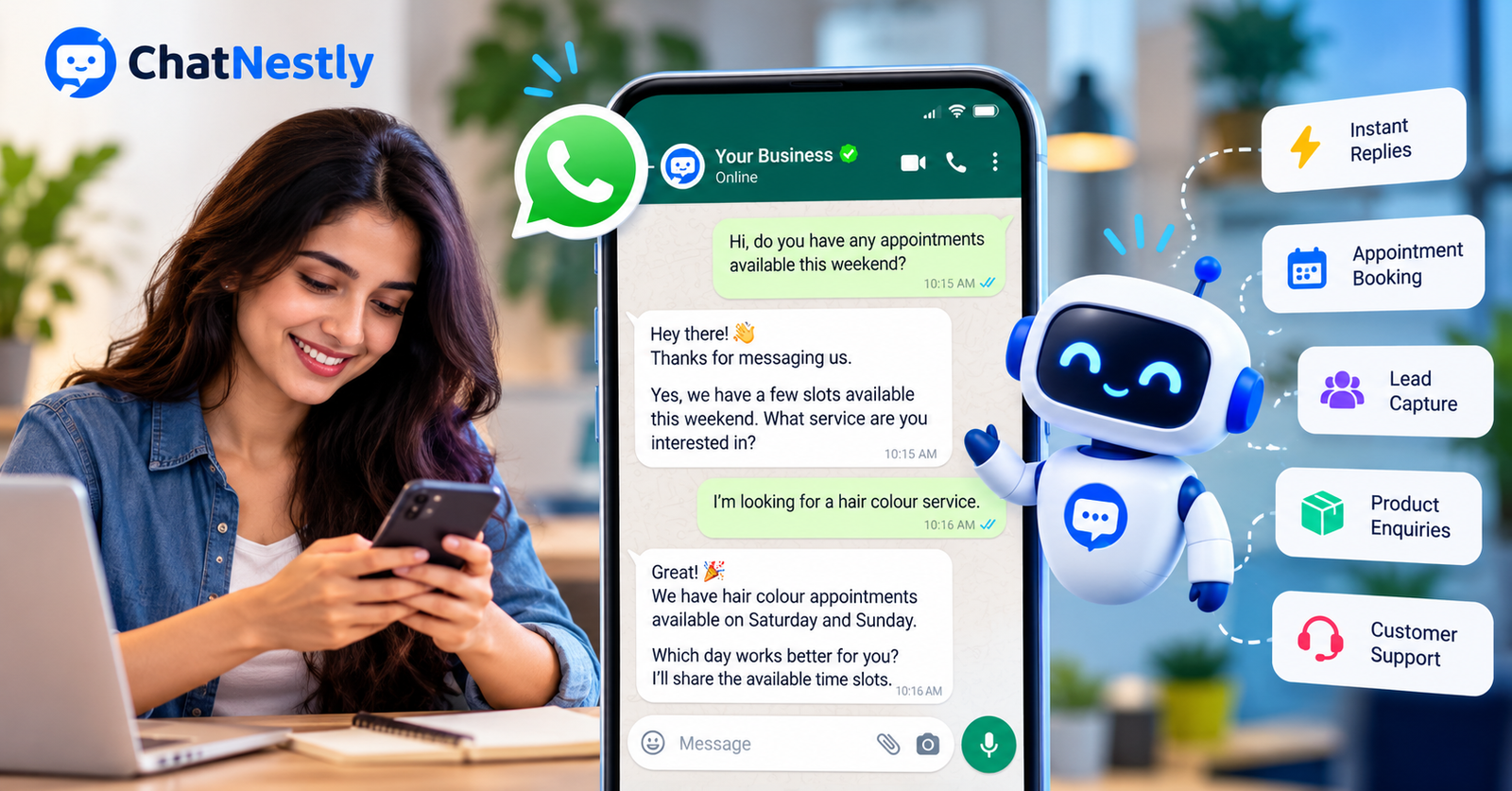
Oct 15, 2026
10 WhatsApp Auto Reply Messages for Business That Sound Human
Customers don't arrange their shopping around your working hours. They message when they have a question, and most expect a fairly quick answer.

Sep 28, 2026
AI Chatbot vs AI Agent: What’s the Difference and Which Does Your Business Need in 2026?
A year or two ago, everything was an “AI chatbot.” Now we have AI agents, customer service agents, support agents and autonomous AI. It sounds impressive, but for a business owner trying to improve customer support, it can also make a simple decision unnecessarily confusing.
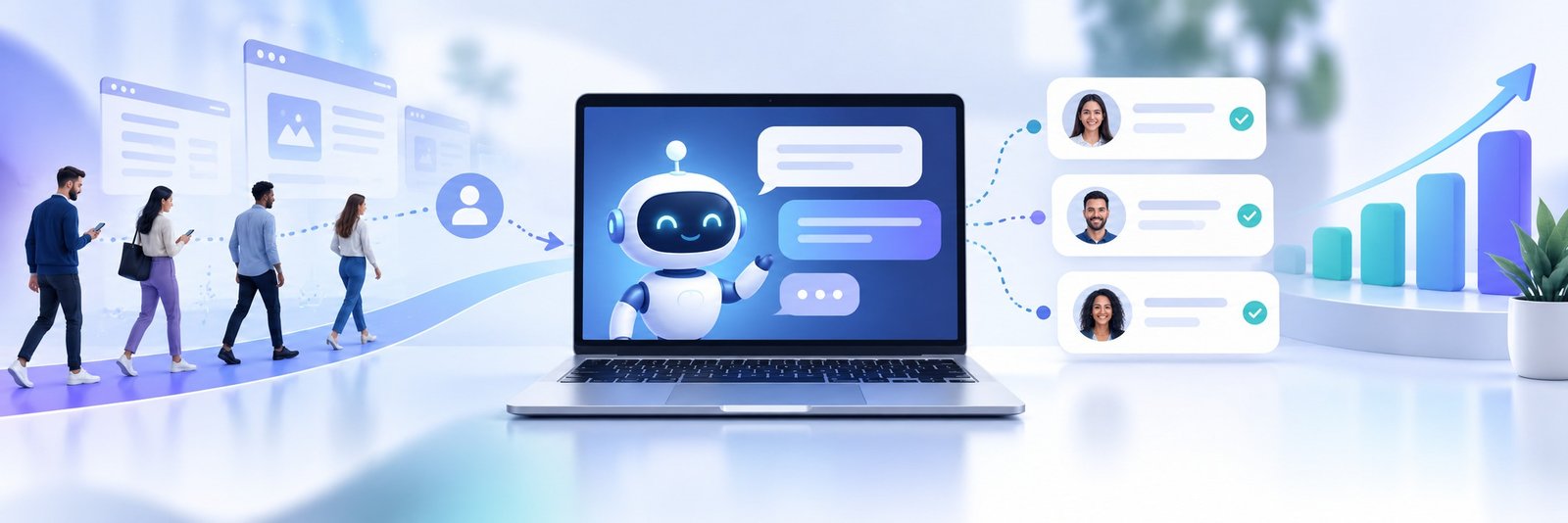
Sep 16, 2026
AI Chatbot for Lead Generation: How to Turn Website Visitors Into Leads
Your website may be getting visitors, but that does not mean those visitors are becoming leads. Many people leave because they still have questions about your product, service, price, delivery, or appointment process.