AI Chatbot vs AI Agent: What’s the Difference and Which Does Your Business Need in 2026?
Listen to this article
Press Play to start listening.
Reader settings

A year or two ago, everything was an “AI chatbot.” Now we have AI agents, customer service agents, support agents and autonomous AI. It sounds impressive, but for a business owner trying to improve customer support, it can also make a simple decision unnecessarily confusing.
So, what’s actually different?
An AI chatbot mainly has conversations with customers. An AI agent goes a step further. It can understand what someone needs, use your business information, take certain actions and decide when a real person should step in.
That difference matters when you’re deciding how much of your customer support you actually want to automate.
What Is an AI Chatbot?
An AI chatbot is software designed to have conversations with people through your website, messaging platform or another digital channel.
Modern chatbots are very different from the old bots that made customers click through endless options like:
“Press 1 for sales.”
“Press 2 for support.”
“Press 3 for billing.”
An AI chatbot for business can understand normal questions and respond using information you provide, such as website pages, FAQs, product information and help documents.
Imagine someone lands on your website at 11:30 at night and asks:
“Do you offer this service in my city?”
If your chatbot has been trained on the right business information, it can answer immediately instead of making that visitor wait until your team comes online the next morning.
That alone can remove a surprising amount of repetitive work.
What Is an AI Agent?
An AI agent is designed to do more than answer a question.
Think about a customer saying:
“I’m interested in your service, but I need to speak with someone about pricing.”
A basic chatbot might explain your pricing.
An AI agent for customer service could understand that the visitor has buying intent, ask a few relevant questions, collect their contact information and pass the conversation to the right person.
In other situations, an AI agent might help with an appointment enquiry, collect lead details, answer an order-related question or escalate an issue when it cannot confidently solve it.
The important part isn't the word “agent.”
It’s the ability to move a conversation forward instead of simply producing another message.
AI Chatbot vs AI Agent: The Simple Difference
Here’s an easier way to look at it.
| AI Chatbot | AI Agent |
|---|---|
| Mainly answers questions | Can answer questions and perform tasks |
| Usually focused on conversation | Focused on reaching an outcome |
| Uses FAQs, documents or website knowledge | Can combine knowledge with actions |
| Useful for repetitive customer questions | Useful for broader customer workflows |
| May direct customers to a human | Can identify when human intervention is needed |
| Best for straightforward support | Better suited to more complex automation |
The line between the two isn’t always perfectly clear. Many modern chatbot platforms now include features that would have been described as “AI agent” capabilities only a short time ago.
That’s why businesses shouldn’t get too caught up in the label.
The better question is: What do you actually want the AI to do?
A Real Example Makes the Difference Clear
Suppose you run an ecommerce store.
A visitor asks:
“Do you ship to Florida?”
Your AI chatbot checks the information it has been trained on and answers the question.
Simple.
Now the visitor says:
“I ordered three days ago. Where is my package?”
That question may require live order information rather than something written on your website.
This is where businesses start needing more than basic question-and-answer automation.
The system may need to identify the customer, retrieve relevant information or move the conversation to someone who can help.
That’s much closer to how an AI customer support agent works.
Why Businesses Are Moving Toward AI Agents
Most businesses don't struggle because customers ask difficult questions all day.
They struggle because customers ask the same questions again and again.
What are your opening hours?
How much does this cost?
Do you deliver here?
How do I book?
Where is my order?
Can I speak with someone?
One question takes only a few minutes to answer. Multiply it by dozens or hundreds of conversations every week, and suddenly a large part of your team's day is disappearing into repetitive support.
Customer service automation helps handle that first layer of conversation.
The goal isn't necessarily to remove people from customer service. It’s to stop your team spending valuable time answering questions that don't really require a person in the first place.
Does That Mean Traditional Chatbots Are Dead?
Not at all.
For many businesses, a well-trained AI chatbot for website support is already enough.
If most visitors ask about services, products, pricing, opening hours, policies or other information already available in your business knowledge, there may be no reason to build complicated automation.
A chatbot can answer those questions around the clock and send more complicated conversations to your team.
That’s useful automation without making things unnecessarily complex.
AI agents become more valuable when you want the conversation to trigger something else.
When Does an AI Agent Make More Sense?
An AI agent starts becoming useful when customers need more than information.
For example, you may want the AI to qualify a potential lead before sending it to sales. You might want it to collect appointment details, deal with common order enquiries or recognize that a frustrated customer needs a human rather than another automated answer.
Here’s a simple way to decide:
| What you need | Better starting point |
|---|---|
| Answer common website questions | AI chatbot |
| Answer questions from your own business content | AI chatbot |
| Provide support outside business hours | AI chatbot |
| Capture visitor contact details | AI chatbot or AI agent |
| Qualify leads during conversations | AI agent |
| Handle multi-step customer requests | AI agent |
| Connect conversations with business actions | AI agent |
| Decide when to escalate complex issues | AI agent with human handoff |
For a small business, starting simple often makes more sense. You can automate common questions first and expand once you know where customers actually need more help.
The Most Important Part Is What Your AI Knows
A clever AI system with poor business information is still going to provide a poor customer experience.
Your AI needs access to accurate information about your company.
That might include your services, product details, FAQs, policies, pricing information, delivery details or support documents.
This is why platforms such as ChatNestly allow businesses to train an AI assistant using their website content and business knowledge.
Instead of expecting a business owner to build hundreds of conversation flows manually, the assistant can use the information the business already has.
For customers, the experience becomes much more natural.
They ask a normal question.
They get a relevant answer.
No hunting through five pages of the website just to find one sentence.
What About WhatsApp?
Customer conversations don't happen only on websites anymore.
For many businesses, WhatsApp is where customers naturally ask questions, follow up and expect quick responses.
That creates the same problem businesses already have on their websites: lots of repetitive conversations and a team that can't realistically be available every hour of the day.
ChatNestly can extend automation to WhatsApp through the official Meta WhatsApp API. Businesses can use automation for customer conversations while also supporting scheduled messages, audience categories and segmented communication.
The useful part is consistency.
A customer shouldn't get a good automated experience on your website and then start from zero when they contact you somewhere else.
AI Should Know When to Stop Talking
This is one part of customer service automation that often gets overlooked.
Sometimes the correct AI response isn't another AI response.
Maybe the customer has an unusual billing problem. Maybe their request isn't covered by the available information. Maybe they simply want to speak with someone.
A useful support system needs a path to human help.
Human handoff allows the AI to handle routine conversations while leaving unusual, sensitive or complicated situations to your team.
That combination is often more practical than trying to automate every single conversation.
So, Which One Does Your Business Need?
Don't choose based on which term sounds more advanced.
Start with your actual customer conversations.
If people mostly ask questions that can be answered from your website, FAQs and documents, a capable AI chatbot may solve most of the problem.
If you need the system to qualify leads, support customer workflows, take actions or make decisions about where conversations should go next, an AI agent becomes more useful.
And you don't necessarily need to make the jump all at once.
A business can start with automated answers, learn what customers actually ask, and gradually introduce more advanced automation where it saves real time.
Start With the Conversations You're Already Having
The easiest place to start isn't with AI technology.
Open your support inbox.
Look at your website enquiries.
Check the questions your team answers every day.
If the same ten or twenty questions keep appearing, you already know where automation can help.
That’s the practical value of tools like ChatNestly. You can train an AI assistant on your business knowledge, answer website visitors 24/7, capture leads, support common enquiries, hand conversations to people when needed and extend automation to WhatsApp.
You don't need to automate everything.
Start with the repetitive conversations your team shouldn't have to answer manually every day.
Want to see what your business could automate? Try ChatNestly and start building your AI customer support experience.
Frequently Asked Questions
What is the main difference between an AI chatbot and an AI agent?
An AI chatbot is mainly designed to communicate with customers and answer questions. An AI agent can go further by working toward an outcome, such as qualifying a lead, handling a request, triggering an action or deciding when a conversation should move to a person.
Can an AI chatbot be trained on my own website?
Yes. Modern business chatbots can use information from website pages, FAQs, documents and other business knowledge. This helps the chatbot provide answers based on your company rather than relying only on generic information.
Can an AI agent replace customer service staff?
AI agents are better suited to handling repetitive and predictable work than replacing an entire support team. Human support remains important for unusual problems, sensitive situations and conversations that require judgment or personal attention.
Is an AI chatbot useful for a small business?
Yes, particularly when a small team spends significant time answering the same questions. An AI chatbot can handle common enquiries outside normal working hours while allowing the team to focus on conversations that actually require human attention.
Can AI customer support work on WhatsApp?
Yes. Businesses can connect AI and automation with WhatsApp using supported business integrations such as the official Meta WhatsApp API. This can help automate common customer conversations, follow-ups and other messaging workflows.
How do I know whether my business needs an AI agent?
Review your customer conversations. If most enquiries simply need information, an AI chatbot may be enough. If customers regularly need actions, multi-step assistance, lead qualification or routing to different people, an AI agent may be a better fit.
About the author
ChatNestly
The ChatNestly Editorial Team shares practical guidance on AI chatbots, customer support automation, lead generation, and building better customer experiences.
Keep reading
Related articles
Oct 15, 2026
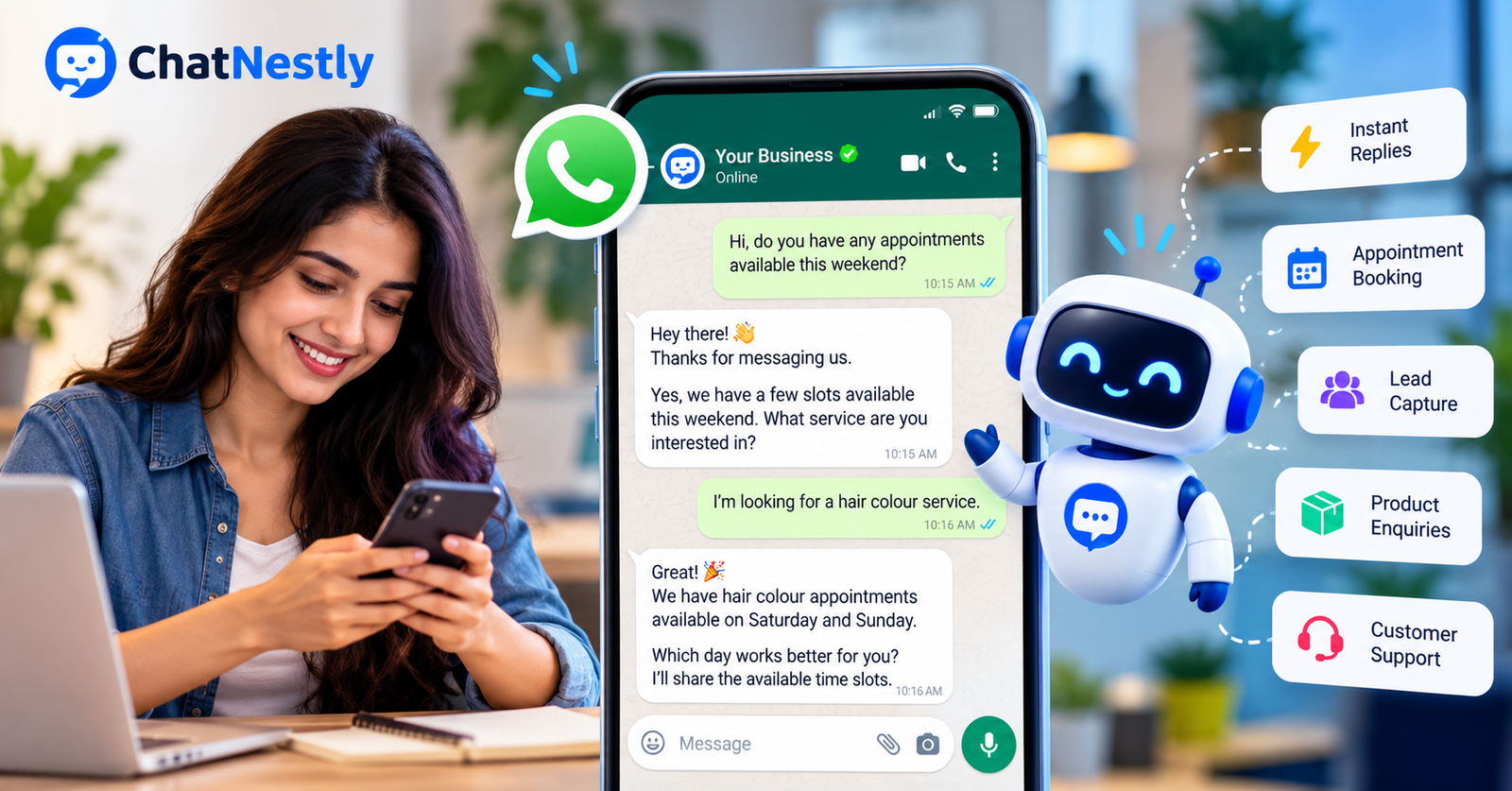
10 WhatsApp Auto Reply Messages for Business That Sound Human
Customers don't arrange their shopping around your working hours. They message when they have a question, and most expect a fairly quick answer.
Sep 16, 2026
AI Chatbot for Lead Generation: How to Turn Website Visitors Into Leads
Your website may be getting visitors, but that does not mean those visitors are becoming leads. Many people leave because they still have questions about your product, service, price, delivery, or appointment process.

Sep 15, 2026
AI Chatbot for Website: How to Add One to Your Site
If your website already has good service pages, product information, FAQs and policies, that's a useful starting point. With ChatNestly, for example, you can use your website content and business documents to give the chatbot knowledge about your business.