AI Chatbot for Business: How ChatNestly Automates Customer Support
Listen to this article
Press Play to start listening.
Reader settings
Running a business means answering questions. A lot of them.
“What does this cost?”
“Are you open today?”
“Can I book an appointment?”
“Do you have this product?”
“Can I talk to someone?”
None of these are bad questions. The problem is that your team may answer the same ones every single day.
That’s one of the reasons we built ChatNestly.
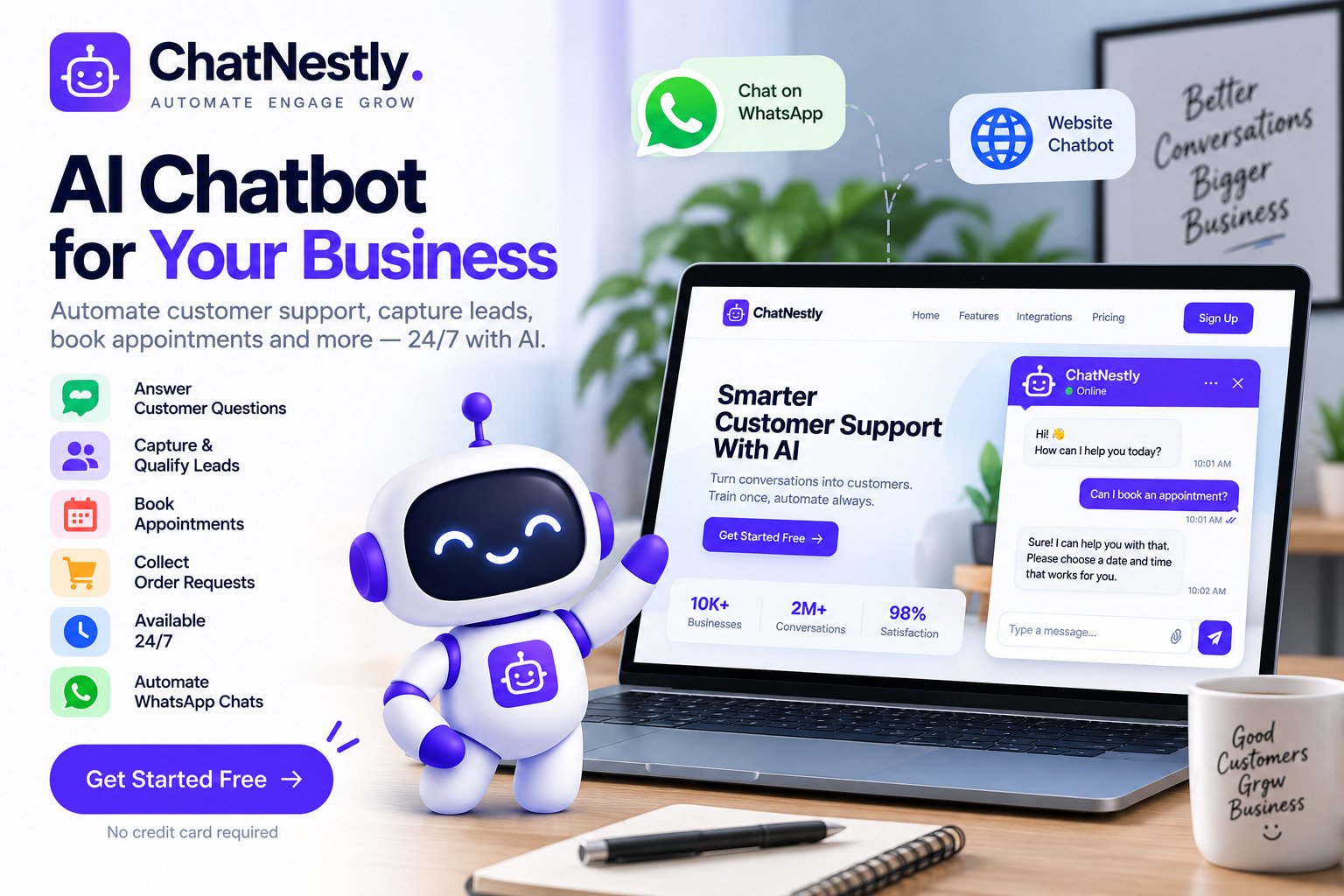
ChatNestly helps businesses handle routine customer conversations using an AI chatbot. It can sit on your website, answer common questions, collect lead details, help with bookings, and stay available when your team has logged off for the day.
The idea isn’t to remove people from customer support. It’s to stop your people from spending half their day copying and pasting the same answers.
What Does an AI Chatbot Actually Do for a Business?
Forget the complicated definition.
An AI chatbot for business is simply another way for customers to get help without waiting for someone from your team to reply.
A visitor comes to your website and asks a question in their own words. The chatbot reads the question and uses the business information you’ve provided to respond.
Say you run a service business. Someone lands on your website at 9:30 PM and wants to know whether you offer a particular service.
Normally, they have two choices: search through your website or send a message and wait until tomorrow.
With an AI chatbot, they can just ask.
That small difference matters.
Why We Built ChatNestly
We kept seeing the same problem: businesses wanted automation, but setting it up often created even more work.
You had to write scripts, build conversation flows, decide what happens after every button click, and keep those flows updated.
That didn't feel particularly helpful.
So with ChatNestly, we wanted to keep things more straightforward. You can give the chatbot information from your website or business documents. It then uses that information when answering customer questions.
You already have the business knowledge. The chatbot simply helps you make better use of it.
Manual Support vs ChatNestly
Here’s what the difference looks like in everyday use:
| Task | Doing It Manually | Using ChatNestly |
|---|---|---|
| Answering FAQs | Staff types the same answers repeatedly | Chatbot handles common questions |
| After-hours questions | Customer waits until you're back | Chatbot can respond 24/7 |
| Capturing leads | Visitor fills out a form | Chatbot can collect details during the conversation |
| Qualifying enquiries | Staff asks basic questions | Chatbot can collect initial information |
| Booking appointments | Several messages back and forth | Customer can be guided through booking |
| Order enquiries | Staff collects details manually | Chatbot can collect order information |
| Difficult questions | Handled by your team | Can be passed to a human |
| WhatsApp conversations | Team handles routine chats | Common conversations can be automated |
The point isn't that every row needs automation.
Automate what wastes time. Keep people involved where they actually add value.
Your Customers Don't Follow Your Working Hours
This is easy to forget.
Your team might finish work at 6 PM, but somebody could discover your business at 10:45 PM.
They have a question right now.
Maybe they'll come back tomorrow. Maybe they'll send an email.
Or maybe they'll open another website and buy from someone else.
A 24/7 AI chatbot gives that visitor a way to keep moving. They can ask about a product, service, price, appointment, or whatever brought them to the website in the first place.
Your team doesn't need to be sitting at a desk for that conversation to happen.
A Chat Can Become a Lead
Website traffic sounds great until you remember that most visitors leave without telling you who they are.
A chatbot can make that interaction less passive.
Suppose someone asks several questions about your service. Instead of answering and ending the conversation, the chatbot can collect relevant contact information and help move the enquiry forward.
That could include a name, email address, phone number, or other details your team needs.
ChatNestly can also help qualify leads by asking useful questions before your team takes over.
So when someone does contact the sales team, you already have some context.
Booking Shouldn't Take Six Messages
We've all seen conversations like this:
“Can I book Tuesday?”
“Sure. What time?”
“Afternoon.”
“Would 2 PM work?”
“No, maybe 4?”
That's a lot of messaging for something fairly simple.
ChatNestly can help collect appointment information through the conversation, making the process easier for the customer and cutting down on unnecessary back-and-forth.
The same applies to order requests. A chatbot can collect basic order details before someone from your team needs to get involved.
Sometimes a Customer Just Needs a Human
AI isn't the right answer to every conversation.
If someone has an unusual issue, a complicated request, or simply wants to speak with your team, they should be able to reach a person.
That's why human handoff matters.
The chatbot handles what it can. Your team steps in when the conversation actually needs them.
That's a much more useful way to think about automation than trying to make a bot handle absolutely everything.
What About WhatsApp?
For many businesses, the website is only one part of customer communication.
A lot of conversations happen on WhatsApp too.
ChatNestly can help businesses automate routine WhatsApp communication through Meta's WhatsApp infrastructure, including customer conversations, follow-ups, scheduled messages, and other supported messaging workflows.
So you don't have to think about website chat and WhatsApp as two completely unrelated systems.
Who Is ChatNestly For?
ChatNestly isn't built for one particular type of company.
An ecommerce store might use it for product questions and leads. A service business might use it for appointments. A SaaS company might use it to answer common product questions. An agency might use it to qualify enquiries before someone from the team gets involved.
There's a simple way to decide whether it could help your business.
Open your customer messages from the last week.
If you see the same questions appearing over and over again, you already know where to start.
Start With the Boring Stuff
You don't need AI handling every customer conversation from day one.
Start with the boring stuff.
Let it answer the questions your team has answered hundreds of times. Let it collect basic lead information. Let customers get help when nobody is online.
Then keep your team focused on the conversations where experience, judgment, and an actual human response matter.
That's what we're trying to do with ChatNestly: make customer support easier to manage without turning automation itself into another full-time job.
Want to see how it works? Register for ChatNestly free, add your business knowledge, and start building your AI chatbot.
Frequently Asked Questions
It doesn’t have to. ChatNestly can handle routine questions while conversations that need personal attention can be handed over to your team.
About the author
ChatNestly
The ChatNestly Editorial Team shares practical guidance on AI chatbots, customer support automation, lead generation, and building better customer experiences.
Keep reading
Related articles

Sep 9, 2026
Best WhatsApp Chatbot for Real Estate in the USA (2026): Features, Pricing & Comparison
Buying or selling a home usually starts with a conversation. Someone sees a property on Instagram. Another person finds a listing through Google. Someone else visits a real estate website late at night and wants to know whether a property is still available.

Aug 29, 2026
AI Chatbot for Website Support and WhatsApp Automation: One Smarter Way to Manage Customer Conversations
Customers don't really care whether they are talking to a website chatbot, a WhatsApp number, or a support team. They simply want a quick answer, the right information, and someone—or something—that understands what they need.

Aug 20, 2026
Best Customer Service AI Chatbots in 2026: Features, Tools & Complete Guide
Customer expectations have changed significantly. People want quick answers, easy communication, and support that is available whenever they need it. For businesses handling hundreds or thousands of customer queries every month, providing fast and consistent support can be difficult with a traditional support team alone.